As solar deployment accelerates, municipalities are rethinking how public spaces receive reliable light. IRENA’s Renewable Capacity Statistics 2024 recorded 473 GW of new renewable capacity worldwide in 2023, with solar contributing the largest share. This growth strengthens the case for solar lighting, but it does not make every design suitable. A shaded road, weak battery, or poorly sealed controller can turn a promising project into a maintenance burden.
This guide examines why choose integrated solar street lights over split types when installation simplicity and compact design matter. Integrated models place the panel, LED module, battery, and controller inside one housing. Picture a narrow rural road with limited equipment access. Fewer cable connections can reduce installation time and potential failure points. That matters. The World Bank’s ESMAP and Lighting Global research repeatedly emphasizes product quality, battery performance, and service support in off-grid solar projects. These factors deserve more attention than impressive lumen claims.
However, integrated does not automatically mean better. Split systems may offer greater panel positioning flexibility, easier battery replacement, or stronger performance under partial shading. The IEA’s Renewables 2024 report highlights solar PV’s rapid expansion, yet large-scale growth does not remove local engineering challenges. Pole spacing, theft prevention, wind loading, seasonal sunlight, and night-time usage patterns still shape the correct choice. Field decisions can be imperfect. A product that performs well in a sunny industrial park may disappoint beside tall buildings. This article compares both configurations through energy yield, installation, maintenance, durability, and total ownership cost, using practical project conditions rather than marketing promises.
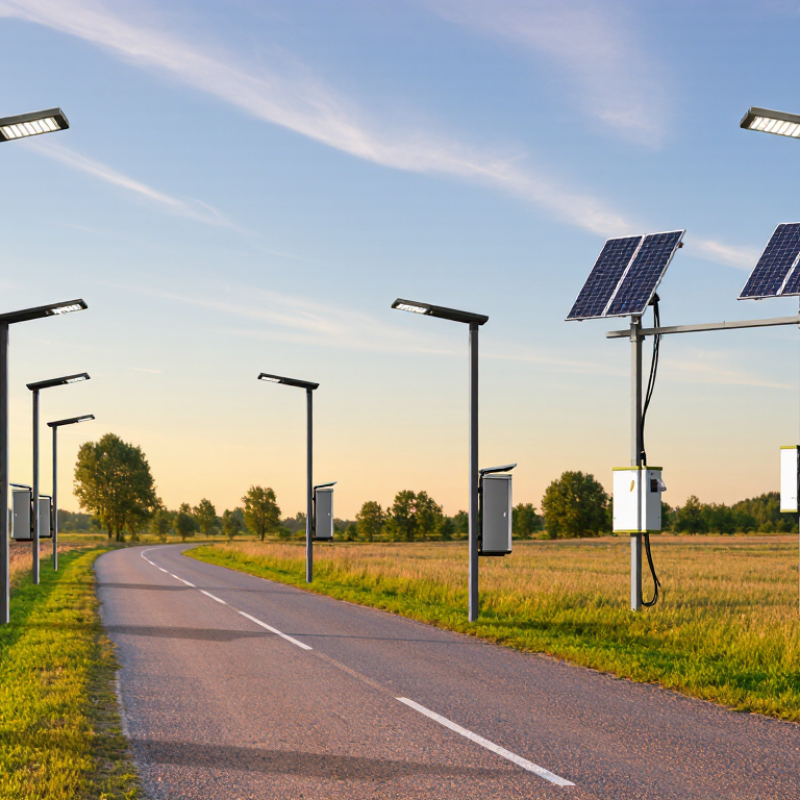
Integrated and split solar street lights serve different installation needs. An integrated model places the panel, battery, controller, and LED unit inside one compact body. It usually installs faster because fewer cables and brackets are required. This design suits open roads, parks, and small parking areas with consistent sunlight. However, its compact structure can make battery replacement or internal inspection less convenient.
A split system separates the solar panel from the lamp and battery. This layout allows technicians to place the panel on a sunnier angle, even when trees or buildings affect the road. It can also support a larger battery, longer lighting hours, and easier component servicing. In field projects, I have found that cable routing needs careful protection from water and accidental damage. That detail is easy to underestimate. Integrated lights look cleaner, but split systems often provide greater adjustment flexibility.
Tips: Check winter sunlight, pole height, battery capacity, and local weather before choosing. Measure nighttime traffic patterns too. A quiet path may need less output than a busy road. Ask for test data under cloudy conditions, not only bright showroom results. Keep maintenance access in mind. It matters later.
| Evaluation Dimension | Integrated Solar Street Light | Split Solar Street Light | Practical Selection Guidance |
|---|---|---|---|
| Basic Design | Solar panel, LED luminaire, battery, controller, and related electronics are housed in one compact fixture. | The solar panel, luminaire, battery, and controller are installed as separate components connected by cables. | Choose an integrated design for a clean, compact installation. Choose a split design when component placement needs to be customized. |
| Installation Complexity | Generally faster to install because the main components are preassembled and fewer interconnecting cables are required. | Usually requires more planning, cable routing, component mounting, and electrical connections. | Integrated models are often more suitable for projects with limited installation time or higher labor costs. |
| Solar Panel Orientation | The panel is attached to the light body, so its tilt and direction may be restricted by the luminaire and pole orientation. | The panel can normally be positioned independently to improve exposure to available sunlight. | Consider a split design where poles are shaded, street layouts vary, or the best panel angle differs from the lighting direction. |
| Space and Appearance | Compact appearance with fewer visible cables and a streamlined profile. | Requires additional space for the panel, battery enclosure, brackets, and wiring. | Integrated units are usually preferred for residential streets, parks, campuses, and visually sensitive locations. |
| Battery Protection | The battery is commonly enclosed within the fixture or a dedicated integrated housing, reducing exposure to tampering and loose connections. | The battery may be installed in a separate housing, pole compartment, or underground enclosure depending on the system design. | Check enclosure sealing, thermal management, physical security, and access for battery replacement before selecting either design. |
| Maintenance Access | A fault in one housing may require access to the complete fixture, although modular internal parts can simplify servicing. | Individual components can often be inspected, replaced, or repositioned separately. | Split systems can be advantageous for large projects where component-level maintenance and future upgrades are priorities. |
| Cable Exposure | Shorter internal connections and fewer external cables generally reduce cable-routing requirements. | Longer external cables may be needed between the panel, controller, battery, and luminaire. | For split systems, use correctly sized, UV-resistant cables and protect connections against water ingress and mechanical damage. |
| Shading Tolerance | Performance can be affected if the fixture-mounted panel is shaded by trees, buildings, poles, or nearby structures. | The panel can be placed away from some obstructions, which may improve solar access. | Conduct a site survey at different times of day and seasons; select split architecture where shading cannot be avoided at the fixture location. |
| System Scalability | The solar panel, battery capacity, and LED output are commonly selected as a matched package. | Panel size, battery capacity, and luminaire power can often be specified more independently. | Split systems provide greater flexibility for high-power lighting, unusual pole spacing, or sites with demanding autonomy requirements. |
| Weather Resistance | The integrated enclosure should have an appropriate IP rating and effective sealing for outdoor exposure. | Each enclosure and cable connection must be protected, and the complete installation must resist rain, dust, and condensation. | Verify the system-level protection, not only the rating of individual components. Proper installation is essential for both designs. |
| Battery Technology | Common configurations use lithium-based batteries because of their compact size, lower maintenance needs, and suitability for repeated cycling. | Lithium-based and other rechargeable battery configurations may be used, depending on enclosure space, cost, and operating conditions. | Compare usable capacity, operating-temperature range, cycle life, protection circuitry, and replacement availability rather than chemistry alone. |
| Lighting Control | Frequently supports dusk-to-dawn operation, scheduled dimming, motion sensing, or remote monitoring when these features are included. | Can support the same control functions, with additional flexibility for separate controller placement and system configuration. | Select controls according to pedestrian activity, traffic conditions, required light levels, and local lighting regulations. |
| Best-Fit Applications | Residential roads, pathways, parks, campuses, parking areas, and projects that value simple installation and a tidy appearance. | High-latitude sites, shaded locations, wide roads, high-output applications, and projects requiring independent component positioning. | Base the decision on solar access, lighting demand, maintenance resources, pole structure, and total project cost. |
| Key Selection Check | Confirm that the panel area, battery capacity, LED output, and operating schedule are sufficient for the local solar resource and required autonomy. | Confirm compatibility among panel voltage, controller, battery, luminaire, cable length, protection devices, and mounting structure. | Request a lighting and energy calculation for the specific site instead of choosing solely by nominal wattage or fixture appearance. |
Selection Tip Integrated designs are typically favored for simplicity and appearance, while split designs are often better when panel positioning, shading control, or component-level flexibility is more important.
It combines the solar panel, battery, controller, and LED lamp in one housing. Fewer cables. Faster installation. Its fixed panel position can limit sunlight collection.
It can suit garden paths, residential lanes, and small parking areas. Open skies help. It works best where sunlight is reliable and maintenance needs are low.
Choose a split design for wide roads, rural intersections, or shaded locations. The panel can sit above trees. The battery and controller remain easier to reach.
Trees, buildings, dust, and low winter sunlight can reduce charging. A bright afternoon may hide seasonal losses. That assumption can fail.
Request maintained illuminance, uniformity, glare, and lighting duration. Do not judge brightness alone. Road width and pole height also matter.
Look for documented autonomy lasting at least three nights. Cloudy weather tests the battery. Actual needs depend on traffic and lighting hours.
A failed battery may require removing the entire light head. That can involve lifting equipment or temporary road access. The compact design is not always easier.
Check temperature, rainfall, dust, wind, drainage, salt exposure, and winter sunlight. Sealed housings help. Laboratory ratings cannot replace site inspection.
Confirm safe battery access and simple panel cleaning. Check spare parts and technician availability. I once focused too much on brightness and underestimated maintenance access.
Choosing between integrated and split solar street lights depends on the project’s layout, installation conditions, and long-term operating goals. Integrated models combine the solar panel, battery, LED lamp, and controller in one compact unit, while split systems place these components separately and connect them through cables. This difference affects installation methods, system flexibility, energy collection, and the ability to position each component for optimal performance. Evaluating brightness, lighting duration, battery capacity, charging efficiency, and control functions can help ensure the selected system meets local requirements.
The question of why choose integrated solar street lights over split types is especially relevant for projects that prioritize simple installation, reduced wiring, compact appearance, and lower routine maintenance. Their enclosed structure can also reduce exposure to cable damage and simplify transportation. However, split systems may be more suitable when larger panels, higher power capacity, adjustable component placement, or challenging environmental conditions are required. By comparing reliability, maintenance access, weather suitability, energy efficiency, and application needs, users can select the most practical solar street light solution for roads, pathways, parking areas, public spaces, and other outdoor locations.

