How to Choose Outdoor LED Flood Light Wattage?

Time:2026-10-22 Author:Liam
0%

Choosing outdoor flood light wattage is not simply a matter of selecting the biggest number. Wattage shows energy use, while lumens describe visible brightness. Two LED flood lights with the same wattage may produce different results because their optics, efficiency, beam angles, and color temperatures vary. That is why understanding how to choose the right wattage for outdoor LED flood lights requires more than reading a product label.

Lighting designer and engineer James R. Benya offers a useful principle: “Good lighting is not about maximum output; it is about useful light delivered where people need it.” This idea matters in real installations. A driveway may need broad, even coverage, while a loading area may require stronger illumination and tighter control. Mounting height changes the result. So do wall color, nearby trees, reflective surfaces, and fixture spacing. A 50-watt light can feel excessive beside a bright white wall, yet appear weak across a dark parking lot.

Start with the area’s purpose, dimensions, and target illuminance. Then compare lumens, beam spread, mounting height, and glare control. Check the fixture’s IP rating for rain and dust exposure. Photocells, timers, and motion sensors can reduce wasted energy. Wattage charts help, but they can mislead when used alone. I have seen installations fail because the buyer focused on wattage and ignored beam distribution. That mistake is easy to make. This guide examines practical sizing methods, common outdoor scenarios, and the limits of simple wattage calculations.
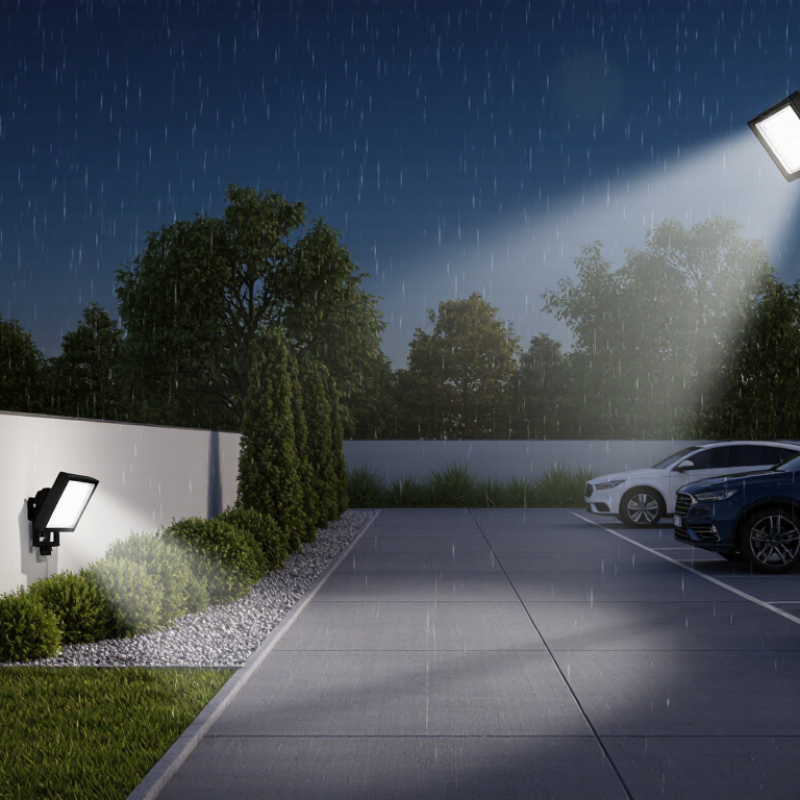
How to Choose Outdoor LED Flood Light Wattage?

Determine the Area Size and Lighting Purpose

How to Choose Outdoor LED Flood Light Wattage?

Determine the Area Size and Lighting Purpose

Wattage should follow the area and lighting purpose, not guesswork. IES guidance measures outdoor lighting in lux, because a parking area, pathway, and sports court need different brightness levels. A 100-square-meter yard may need only 5–10 lux for safe movement. Security zones may require stronger, more uniform lighting. The U.S. Department of Energy’s solid-state lighting reports show laboratory LED efficacy can exceed 200 lumens per watt, but complete fixtures deliver less after optics, heat, and driver losses.

Use this practical estimate: required lumens = area × target lux ÷ utilization factor ÷ maintenance factor. For a 100-square-meter yard at 10 lux, with 0.5 utilization and 0.8 maintenance factors, the fixture should provide about 2,500 delivered lumens. At roughly 100–130 lumens per watt, a 20–25-watt flood light may work. Beam angle and mounting height can change the result. I still recheck the calculation on site. A neat wattage answer can be wrong.

Tips: Measure the actual area first. Choose a wider beam for open yards and a narrower beam for walls or gates. Avoid aiming directly toward windows, roads, or neighboring homes. Test one fixture after dark before buying several. Reflections from pale walls can increase perceived brightness, while trees and textured surfaces absorb it.

How to Choose Outdoor LED Flood Light Wattage?

Recommended LED wattage depends on the area size and lighting purpose. The estimates below assume approximately 100 lumens per watt, 60% effective light utilization, and average target illuminance of 10 lux for security, 20 lux for pathways, and 50 lux for outdoor task lighting.

Use higher wattage for darker surfaces, greater mounting heights, wide beam angles, or locations requiring stronger illumination. For glare control and energy efficiency, select the lowest wattage that meets the intended illuminance level.

Assess Required Brightness Using Lumens and Coverage

Choosing outdoor LED flood light wattage starts with lumens, not watts. Watts measure energy use, while lumens measure visible output. The U.S. Department of Energy’s 2023 Solid-State Lighting R&D Opportunities report notes that some LED packages exceed 200 lumens per watt in laboratory conditions. Real fixtures deliver less after lenses, drivers, heat, and mounting angles. Do not size a light from package wattage alone.

Measure the target area first. For example, 4,000 lumens spread across 400 square feet provides about 10 lumens per square foot before losses. A driveway may need less brightness than a loading zone or sports area. IES guidance uses illuminance levels, measured in lux or footcandles, because brightness depends on distance and distribution. A narrow beam can create harsh hotspots, while a wide beam may leave the center underlit. Coverage matters more than impressive lumen numbers.

Use a simple field check. Place a temporary light at the planned height, then inspect the darkest edges after sunset. The Illuminating Engineering Society recommends evaluating uniformity, glare, and task visibility, not brightness alone. I sometimes overestimate usable coverage by ignoring trees, walls, and dirt on the lens. That mistake is costly. Select a fixture with suitable optics, then allow roughly 20–30% output margin for aging and environmental losses. Avoid choosing extra wattage just because the area looks dramatic in a catalog.

Match LED Wattage to Beam Angle and Mounting Height

How to Choose Outdoor LED Flood Light Wattage?

Match LED Wattage to Beam Angle and Mounting Height

Outdoor LED flood light wattage should match both mounting height and beam angle. Wattage alone can mislead because LED efficiency differs between fixtures. Check lumens, beam distribution, and the area’s required brightness before choosing a model. A wide beam spreads light across a driveway, but it loses intensity quickly. A narrow beam sends more light toward distant ground.

At a three-meter mounting height, a 20–30 watt flood light with a 90-degree beam may suit a small entrance. For a six-meter pole, a 40–80 watt fixture with a 30–60-degree beam often provides better coverage.

These figures are starting points, not guarantees. Dark walls, trees, and uneven ground can absorb or interrupt useful light. Measure the target area whenever possible.

My first outdoor installation used too much wattage with a wide beam. The yard looked bright, but the boundary remained poorly defined. I later aimed a narrower beam lower and reduced glare near the windows. That adjustment worked better than simply adding power.

Mounting height also changes the footprint: higher fixtures cover more ground, while illumination becomes weaker. Avoid pointing the light directly toward neighboring homes or drivers. A simple evening test can reveal shadows, glare, and missed areas before permanent mounting.

Consider Color Temperature, Efficiency, and Outdoor Conditions

How to Choose Outdoor LED Flood Light Wattage?

Consider Color Temperature, Efficiency, and Outdoor Conditions

Choosing outdoor LED flood light wattage requires more than measuring the yard. Start with the scene. A small entrance may need 10–20 watts, while a broad driveway can require 30–60 watts. The correct choice depends on mounting height, beam angle, surface color, and the light level already present.

Color temperature changes how brightness feels. Warm white, around 2700–3000K, creates a comfortable appearance near patios and residential entrances. Neutral white, around 3500–4500K, can improve visibility around paths and work areas. Cooler light may look sharper, but it can appear harsh and produce more glare. That assumption fails when reflective walls or wet pavement are nearby.

Efficiency matters because wattage only shows energy use. Check lumens, or actual light output, before comparing fixtures. A modern 30-watt light may outperform an older 50-watt model. In practical installations, I would also check the beam pattern at night, not only the product label. Outdoor conditions complicate the calculation. Dust, rain, snow, and temperature changes can reduce performance over time. Choose suitable weather protection, secure mounting, and enough wattage for seasonal darkness. More power is not always better. Excessive brightness can disturb neighbors, create deep shadows, and waste electricity. A cautious trial installation often reveals mistakes before permanent mounting.

Compare Fixtures and Confirm the Best Wattage Choice

Choosing outdoor LED flood light wattage starts with comparing fixtures, not reading wattage alone. Wattage shows energy use, while lumens show delivered brightness. I compare lumen output, beam angle, mounting height, and light distribution. A 50-watt fixture may suit a narrow driveway, but a wide yard may need a lower-wattage fixture with broader coverage. Check the photometric file when available. It reveals where light actually lands.

Mounting height changes the decision. A fixture installed eight feet high needs less output than one mounted twenty feet high. Dark walls, trees, and uneven ground also absorb or block light. For security areas, I look for even illumination instead of a harsh bright spot. A basic lux meter can expose weak corners after installation. Test at night.

Do not ignore fixture quality. Compare weather resistance, operating temperature, surge protection, color temperature, and dimming compatibility. Outdoor exposure is demanding. A poorly sealed housing can reduce performance long before the LEDs fail. My early estimates were often too high because I focused on wattage and ignored beam spread. I now install the closest practical option, observe shadows and glare, then adjust. Sometimes a 30-watt fixture works better than a 70-watt model. Confirm the choice through real coverage, measured brightness, and comfortable visibility.

FAQS

Should outdoor flood light wattage be chosen by area size alone?

No. Consider area, target brightness, beam angle, mounting height, and surface conditions. Wattage alone can mislead.

How can I estimate the required light output?

Use this formula: required lumens = area × target lux ÷ utilization factor ÷ maintenance factor.A 100-square-meter yard may need about 2,500 delivered lumens at 10 lux. Check the result outdoors.

How many watts might a 100-square-meter yard need?

A 20–25-watt fixture may work with roughly 100–130 lumens per watt. This remains an estimate.Trees, walls, and dark surfaces can reduce useful coverage. The neat calculation may still be wrong.

Why are lumens more useful than watts?

Lumens show visible light output. Watts show electricity consumption.A modern 30-watt fixture may produce more light than an older 50-watt fixture. Compare delivered lumens instead.

How does beam angle affect flood light selection?

Wide beams suit open yards and broad driveways. Narrow beams suit walls, gates, and focused areas.A narrow beam can create bright hotspots. A wide beam may leave the center too dim.

What brightness level does a driveway usually need?

A driveway often needs less light than a loading area or sports court. The exact level depends on visibility and safety needs.Inspect the darkest edges after sunset. Catalog brightness can feel very different outside.

Which color temperature works best outdoors?

Warm white around 2700–3000K suits patios and residential entrances. Neutral white around 3500–4500K suits paths and work areas.Cooler light may look sharper. It can also create harsh glare near wet pavement or reflective walls.

What outdoor conditions can reduce lighting performance?

Dust, rain, snow, heat, and cold can reduce output over time. Dirty lenses also block useful light.Choose suitable weather protection and secure mounting. I sometimes overlook maintenance, and that mistake costs brightness.

Should I install the highest-wattage fixture available?

No. Excessive brightness can waste electricity, disturb neighbors, and create deep shadows.Test one fixture after dark before buying several. A cautious trial often reveals poor aiming or coverage.

Conclusion

Choosing the right outdoor LED flood light wattage begins with understanding the size of the area and its lighting purpose. A small entrance, pathway, or garden may require less power than a large driveway, sports space, warehouse yard, or security zone. Instead of judging wattage alone, evaluate the required brightness in lumens and consider how much area the fixture can cover. Higher wattage generally produces more light, but the final result also depends on the beam angle, mounting height, and fixture design. A wide beam angle spreads light across a larger space, while a narrow beam angle provides more focused illumination.

When deciding how to choose the right wattage for outdoor LED flood lights, also consider color temperature, energy efficiency, weather resistance, and operating conditions. Cooler light can improve visibility for security applications, while warmer light may create a more comfortable atmosphere. Compare fixtures by lumens, beam distribution, efficiency, durability, and installation height rather than wattage alone. Testing the lighting effect or using a basic lighting plan can help confirm that the selected wattage provides balanced, reliable coverage without excessive brightness or energy use.

Liam

Liam

Liam is a dedicated marketing professional with a profound expertise in the industry, where he excels at highlighting the unique advantages of our core products. With a keen understanding of market trends and consumer needs, Liam frequently updates our company’s professional blog, providing......