Outdoor LED systems face heat, cold, sunlight, wind, and sudden weather changes throughout the year. These conditions affect brightness, color consistency, power use, and component life. A fixture that performs well on a mild spring evening may behave differently during a hot summer afternoon.
So, how do temperature changes affect outdoor LED performance? Heat can raise junction temperatures, accelerate lumen depreciation, and place extra stress on drivers and power supplies. Cold weather may improve LED efficiency, but it can affect wiring flexibility, battery capacity, and startup behavior. Rapid temperature shifts also create condensation risks inside poorly sealed housings.
Real-world installation experience shows that thermal design matters as much as LED chip quality. Aluminum housings, ventilation paths, thermal interface materials, and correctly rated drivers all influence long-term reliability. IP ratings help resist water and dust, but they do not automatically solve every thermal problem. That distinction is often overlooked.
Manufacturers typically evaluate products through temperature cycling, humidity exposure, and electrical safety testing. Still, published laboratory results may not reflect a dusty roadside, a rooftop with limited airflow, or a sign facing direct afternoon sun. Field conditions can be less predictable.
This guide examines the main temperature effects on outdoor LED performance. It also considers installation choices, maintenance routines, and practical specifications. Some conclusions depend on product design and local climate. That uncertainty deserves attention. Recognizing it helps buyers and technicians make safer, more reliable decisions.
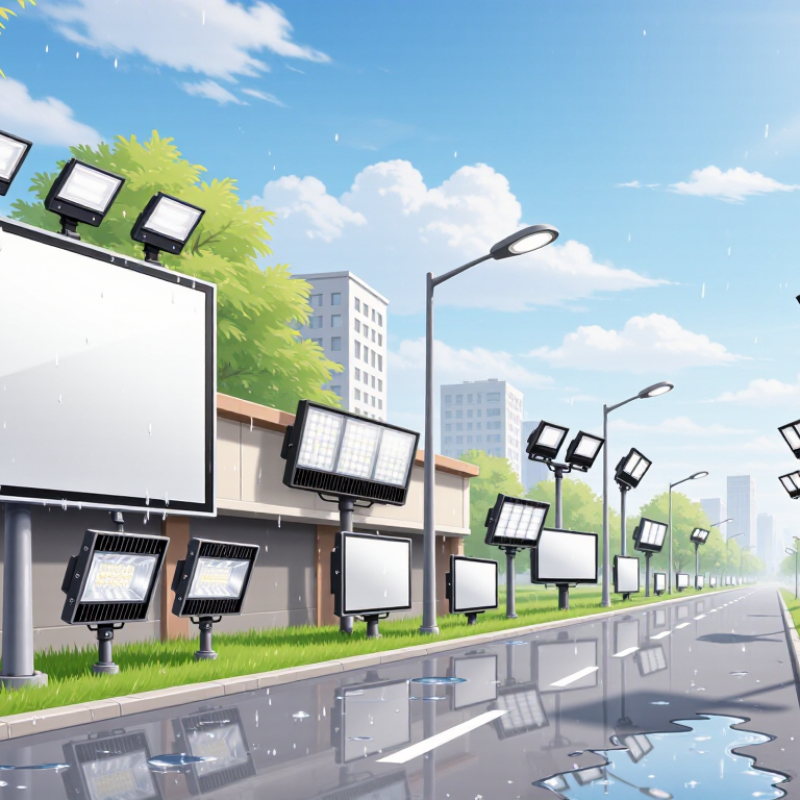
Outdoor LED performance changes through its components, not just visible brightness. As ambient temperature rises, LED junction temperature can climb far above air temperature. The U.S. Department of Energy’s Solid-State Lighting Technology Fact Sheet explains that higher junction temperatures reduce efficacy and accelerate lumen depreciation. In practical testing, many high-power LEDs show roughly 0.2–0.5% lower output per °C above a reference point. The exact result depends on package design. A hot black housing under direct sun can dim sooner than a shaded unit.
The driver may become the weakest link. Electrolytic capacitor life often follows a 10°C rule: each 10°C reduction can approximately double rated life. This reliability principle appears in IEC TR 62380 and thermal-design guidance. Cold weather creates different problems. Start-up current, cable flexibility, and condensation matter more. DOE and IES methods, including LM-80 and TM-21, measure lumen maintenance under controlled temperatures. However, they cannot predict every outdoor installation. That gap matters. Treating “50,000 hours” as a guarantee is convenient, but wrong.
Tips: Check the complete operating-temperature range, not only LED chip data. Specify driver ratings separately. Use thermal imaging during peak summer heat. Keep airflow around the housing, protect vents from dust, and provide a drainage path for moisture. For cold locations, verify minimum start temperature and surge behavior. Recheck optical seals after a wet season; small failures often appear before visible dimming.
Outdoor LED performance changes noticeably between winter nights and summer afternoons. In cold weather, LED chips usually convert electricity more efficiently. The U.S. Department of Energy reports that lower operating temperatures can improve LED efficacy and support longer component life. Cold air also helps remove heat from the housing.
Cold helps.
However, condensation can form inside poorly sealed luminaires, especially when warm daytime air meets a frozen enclosure. Moisture may corrode connectors, cloud lenses, or trigger intermittent faults.
Hot weather is less forgiving. As the LED junction temperature rises, light output and efficacy generally decline. The Illuminating Engineering Society’s LM-80 standard evaluates lumen maintenance at 55°C, 85°C, or manufacturer-selected temperatures, showing why thermal testing matters. The U.S. Department of Energy also identifies heat management as a major factor in LED lifetime and lumen maintenance.
Heat wins nothing.
A dark metal housing under direct sun can become far hotter than the surrounding air. Drivers may derate, shut down, or age faster when airflow is restricted by dust.
Field checks should record ambient temperature, housing temperature, current, and measured illuminance.
A thermal camera can reveal hotspots near the driver or mounting plate. I have seen specifications focus on “50,000 hours” while ignoring installation temperature. That is an incomplete view. The figure may describe laboratory conditions, not a coastal road, snowy parking lot, or sun-baked sign.
Designers should review thermal derating curves, IP protection, ventilation, condensation control, and seasonal light measurements before approving an outdoor installation.
Temperature changes can alter both the brightness and color accuracy of outdoor LED displays. In field checks, a dark cabinet can reach 55°C under direct summer sun. As the LED junction heats, light output often falls, while long exposure may accelerate component aging. The display can look visibly dimmer by late afternoon. Heat also affects driver efficiency and internal power regulation.
Cold conditions create a different response. LEDs may produce slightly more light at low temperatures, but the driver may need extra warm-up time. At -10°C, startup behavior can become uneven, especially when moisture freezes near seals or connectors. Color accuracy can shift as the LED junction temperature changes. White tones may appear cooler or warmer than the calibrated target. Small shifts are easy to notice in skin tones, gray backgrounds, and traffic imagery.
Thermal sensors help.
Reliable installations combine airflow, heat paths, and temperature-based calibration. A cabinet thermometer alone is not enough; the LED junction can be much hotter than the surrounding air. During maintenance, compare brightness readings across the panel at morning, noon, and evening. Recalibration may be needed after major seasonal changes. I have found that scheduled checks reveal problems earlier than visual inspection alone. Still, temperature is only one factor. Power stability, humidity, dust, and calibration quality can produce similar symptoms, so diagnosing color drift requires patience and measured data.
Temperature swings test outdoor LED systems more severely than indoor installations. At noon, a dark metal housing can become hot enough to raise the LED junction temperature sharply. At night, rapid cooling can stress solder joints, seals, and driver components. The U.S. Department of Energy’s 2023 Solid-State Lighting R&D Opportunities report identifies thermal management as a continuing challenge for LED efficiency and reliability.
Heat must leave the junction efficiently. Use an adequately sized heat sink, clear airflow paths, and thermally conductive interfaces. Keep the driver away from the hottest internal zone when possible. Field measurements should include ambient temperature, housing temperature, and junction-temperature estimates. A small sensor placed near the LED board can reveal problems missed during laboratory testing. It is not perfect, but it is useful.
Cold weather usually improves LED efficacy, yet it can expose weak capacitors, brittle gaskets, and unsuitable control components. IES LM-80-21 measures lumen maintenance, while IES TM-21-21 projects performance from that evidence; neither replaces site-specific thermal testing. The ENERGY STAR Luminaires specification also evaluates lumen maintenance over defined operating periods, commonly 25,000 or 35,000 hours, depending on the product category. Those numbers describe controlled conditions, not every rooftop or roadside enclosure. Designers should derate components conservatively and review seasonal data after installation. A single hot summer may reveal more than a clean laboratory test.
| Ambient Temperature | Typical Effect on LED Performance | Relative Light Output Trend | Thermal and Electrical Risk | Recommended Thermal Management |
|---|---|---|---|---|
| −40°C to −20°C | Cold conditions generally improve LED efficiency and can reduce LED junction temperature. However, driver components, seals, plastics, and cable materials may become less flexible. | Usually stable or slightly increased | Low LED thermal risk; increased risk of start-up stress, condensation, brittle materials, and reduced battery performance. | Use components rated for the minimum ambient temperature. Provide condensation control, flexible cable insulation, and a driver with a verified cold-start specification. |
| −20°C to 0°C | LED electrical efficiency is commonly favorable, while optical output remains stable when the power supply operates within its specified range. | Stable to slightly increased | Low thermal stress; possible driver start-up delay and moisture-related reliability issues during freeze–thaw cycles. | Use sealed enclosures with suitable pressure equalization. Check cold-start behavior and protect connectors against water ingress. |
| 0°C to 25°C | This range is generally favorable for outdoor LED operation. Heat generation is easier to dissipate, and light output is normally close to the design reference value. | Approximately 100% at the design reference point | Low thermal risk when the luminaire has adequate heat dissipation and unobstructed airflow. | Use an appropriately sized heat sink, maintain clean ventilation paths, and verify the driver’s rated operating range. |
| 25°C to 40°C | LED junction temperature rises as ambient temperature increases. Light output and efficacy begin to decline gradually, especially in compact or enclosed luminaires. | Typically decreases gradually | Moderate thermal stress; accelerated aging of the LED package, driver capacitors, seals, and optical materials may occur. | Increase heat-sink surface area, improve thermal interface quality, reduce unnecessary drive current, and avoid direct solar heat gain where possible. |
| 40°C to 50°C | Higher ambient temperature can significantly raise LED junction temperature. Thermal regulation may reduce drive current to prevent overheating, lowering light output. | Often reduced by approximately 5%–15%, depending on design | Moderate to high thermal stress; long-term lumen maintenance and driver service life may decline. | Use a larger or finned heat sink, improve enclosure airflow, provide thermal protection, and select a driver designed for high-temperature operation. |
| 50°C to 60°C | Thermal resistance becomes a major performance factor. Enclosed fixtures may experience substantial junction-temperature rise, reducing efficacy and accelerating material degradation. | May decrease by approximately 10%–25% or more, depending on junction temperature | High risk of thermal throttling, shortened driver life, color shift, seal degradation, and premature failure. | Use derating curves, lower operating current, high-temperature-rated components, improved heat spreading, and installation layouts that minimize solar loading. |
| Above 60°C | Operation may exceed the rated ambient range of many outdoor LED systems. Light output, color stability, and reliability can deteriorate rapidly if heat is not controlled. | Potentially reduced substantially or limited by protection circuitry | Very high thermal risk, including driver shutdown, accelerated lumen depreciation, solder-joint stress, and permanent component damage. | Confirm the product’s maximum ambient rating, apply current derating, increase heat dissipation, provide shading or ventilation, and do not operate beyond certified limits. |
Outdoor LED fixtures face more than simple temperature changes. Cold air can reduce battery efficiency, stiffen cable insulation, and slow electronic response. Heat increases internal pressure and may shorten driver life. Rapid shifts create condensation inside poorly sealed housings. That moisture can corrode terminals and cloud lenses.
A weather-resistant design needs more than a sealed front cover. Look for strong gaskets, protected cable glands, drainage paths, and materials that tolerate ultraviolet exposure. Thermal expansion also matters. Metal brackets and plastic housings expand differently, so mounting points should allow slight movement without loosening. In coastal areas, salt deposits deserve extra attention. They can damage connectors before visible rust appears.
Maintenance should follow the local climate. Inspect seals before the wet season, then check drainage after heavy rain. In winter, remove ice gently and avoid sudden hot water. During summer, clear dust from ventilation areas and measure unusual surface heat. Check flickering, color shifts, loose brackets, and water marks inside lenses. Small faults become expensive quickly.
I once underestimated condensation.
That mistake is worth remembering. Weather ratings are tested under defined conditions, not every real installation. A fixture may meet a protection standard yet fail when mounted beneath a cold roof with poor airflow. Record inspection dates, operating temperatures, and recurring faults. Those simple notes make seasonal decisions more reliable.
Heat raises the LED junction temperature above the surrounding air. Output may fall by about 0.2–0.5% per degree Celsius. A dark cabinet under direct sun can become very hot.
Yes. Junction heat can shift white tones toward warmer or cooler colors. These changes appear clearly in skin tones, gray backgrounds, and traffic images. Small shifts matter.
Often, yes. Driver capacitors can age faster in sustained heat. Lowering operating temperature may greatly extend their service life. The driver deserves separate inspection.
Cold can slow startup, stiffen cables, and increase warm-up time. At very low temperatures, startup may become uneven. Frozen moisture near connectors can worsen the problem.
No. A stated lifetime usually reflects controlled conditions. Actual results depend on heat, moisture, dust, power stability, and maintenance. Treat long-life claims cautiously.
Use thermal sensors or an infrared camera during peak summer heat. Compare brightness readings in the morning, afternoon, and evening. A cabinet thermometer alone may miss hotter internal components.
Look for durable gaskets, protected cable glands, drainage paths, and ultraviolet-resistant materials. Mounting points should allow small thermal movements. Sealed does not mean moisture-proof forever.
Inspect seals before wet weather and check drainage after heavy rain. Remove ice gently during winter. Clear dust from vents during summer. I once underestimated condensation. That mistake still matters.
Temperature changes can strongly influence outdoor LED performance by affecting the components that control light output, power use, and service life. In cold conditions, LEDs may operate efficiently but can experience slower startup, material contraction, and reduced battery or driver performance. In hot weather, excessive heat can increase electrical stress, accelerate component aging, and cause brightness reduction. These changes may also affect color accuracy, leading to shifts in tone when the system is exposed to repeated or extreme temperature cycles. Understanding how do temperature changes affect outdoor LED performance is essential for maintaining consistent illumination in demanding environments.
Reliable operation depends on effective thermal management, including proper ventilation, heat dissipation, and suitable installation practices. Weather-resistant housings, sealed connections, and durable materials help protect LED systems from moisture, dust, and seasonal exposure. Regular maintenance should include checking ventilation paths, inspecting seals and cables, cleaning heat-dissipating surfaces, and confirming stable brightness and color output. With thoughtful design and seasonal care, outdoor LED systems can deliver dependable performance throughout changing weather conditions.
